
The Last Warning

I humbly apologize I do not remember who this photo prompt is from anyone know? James (HVR) Alicia Labyrinthia Mythweaver Conor MacCormack Mark Crutchfield
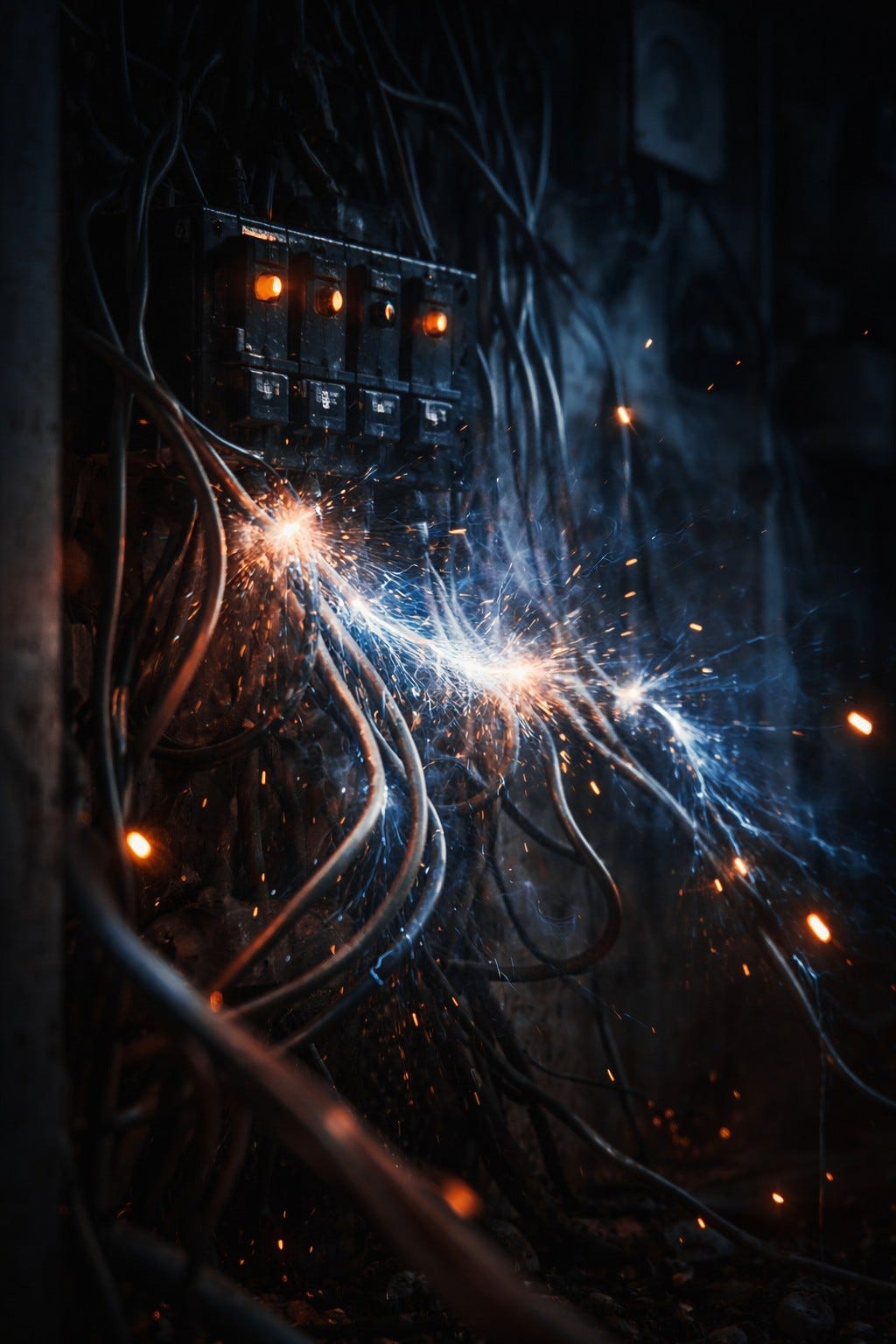
The year was 2035.
The world wanted to live better, cleaner, and greener. Governments around the globe pushed for change, and eventually everyone was required to own an electric vehicle.
Gas stations disappeared.
Their familiar pumps were torn out and replaced with rows of charging stations. The smell of gasoline faded into memory. Highways became quieter. Cities became cleaner.
The world had become electrified.
Years earlier, engineers and utility experts had warned that if society was going to depend almost entirely on electricity, the power grid would need massive upgrades. New power plants would be needed. Aging transmission lines would have to be replaced. Substations would need expansion.
But those warnings were expensive.
And inconvenient.
So they were ignored.
Politicians promised the grid was ready.
Corporations assured everyone the technology would keep pace with demand.
Most people never gave it a second thought.
After all, the lights still came on when they flipped the switch.
Until the day they didn’t.
One hot morning in July, the hottest it had been in years, the electrical grid was already straining.
Air conditioners hummed in homes from coast to coast. Schools and offices had closed as temperatures climbed well past one hundred degrees in many areas.
To make matters worse, a new virus had begun spreading around the world.
Millions of people stayed home.
They worked on computers.
They streamed movies.
They watched television.
They charged phones, tablets, laptops, and smart devices.
And, of course, they plugged in their cars.
No one thought much about it.
After all, that’s what electricity was for.
The demand climbed steadily throughout the morning.
Power stations reported record usage.
Utility companies issued conservation notices.
Most people ignored them.
By noon, charging stations were full.
By two o’clock, transformers in several cities were operating beyond their recommended limits.
By four o’clock, engineers began to worry.
By six o’clock, they began to panic.
The grid had never been designed for this.
Too many air conditioners.
Too many computers.
Too many televisions.
Too many chargers.
Too many electric cars drawing power from a system that had been patched, upgraded, and stretched for decades, but never truly rebuilt.
Then, at 6:17 p.m., a transformer outside Phoenix exploded.
Most people never heard it.
What they heard instead was the sudden silence when their lights went out.
And that was how it began.
The largest blackout in human history.
Meanwhile, in Tallahassee, Florida, Mrs. Holloway sat awake in Room 214 of the Magnolia Hotel.
For weeks she had complained that the walls whispered at night.
The manager smiled politely.
The electrician found nothing.
The guests laughed.
But every night the voices grew louder.
Tiny crackles.
Soft pops.
A language spoken in sparks and static.
Mrs. Holloway could never make out the words. She could only hear the urgency in them.
The desperation.
The warning.
Then came the storm.
Lightning flashed somewhere beyond the hills, and every light in the hotel flickered at once.
For one brief second, every television shut off by itself.
Every radio hissed.
Every alarm clock displayed the same message.
WE TRIED TO WARN YOU
A heartbeat later, the power failed.
Completely.
The hotel stood in darkness.
Guests stumbled into hallways illuminated only by emergency exit signs.
Elevators froze.
Air conditioners fell silent.
The world seemed to hold its breath.
Except for one room.
Room 214.
Its light remained on.
A pale glow spilled beneath the door.
And beneath the floorboards, hidden behind old plaster and forgotten wiring, something finally woke up.
Something that had been whispering for years.
Something that knew exactly what was coming.
No one noticed the strange light racing along the power lines.
It moved too fast to be seen by the human eye.
A pulse of blue-white energy shot from Tallahassee, leaping from transformer to transformer, substation to substation, following the electrical veins that connected the nation.
Northward.
Toward Atlanta.
There, at a roadside motel just off Interstate 75, another guest was making complaints.
The room number was 214.
For three nights he had reported whispering in the walls.
The motel manager blamed old pipes.
The maintenance man blamed loose wiring.
The other guests blamed too much television.
Yet every night the voices grew louder.
Tiny crackles.
Soft pops.
A language spoken in sparks and static.
The guest had begun writing down what he thought he heard.
Most of it was nonsense.
Fragments.
Broken words.
But one phrase appeared over and over.
Too late.
As darkness spread across the South, the strange pulse arrived.
The lights in Room 214 flickered.
The television switched on by itself.
The lamp beside the bed glowed brighter and brighter until the bulb should have burst.
Instead, the light gathered.
It twisted.
It listened.
And somewhere far away, beneath the floorboards of another Room 214 in Tallahassee, something answered.
For the first time, the voices were no longer alone.
Days passed.
Then weeks.
The blackouts spread, but not in the way experts expected.
The strange energy moving through the grid traveled slowly, following transmission lines, substations, transformers, and forgotten wires buried beneath cities and fields.
At first, nobody connected the incidents.
A motel in Georgia.
An apartment building in Tennessee.
A truck stop in Missouri.
Each report sounded ridiculous on its own.
Someone claimed they heard whispering in the walls.
Someone else swore a lamp answered when spoken to.
A child insisted the kitchen outlet was trying to tell her something.
Engineers dismissed the stories.
Scientists ignored them.
The news laughed.
Then the phenomenon reached Nebraska.
Drivers pulled into a charging station outside Kearney and plugged in their vehicles.
Everything appeared normal.
Then charging pump 214 sparked.
The car connected to it suddenly powered on.
Its dashboard lit up.
The radio hissed.
The headlights flashed twice.
Then everything went dark.
A moment later, every charger in Row 214 sparked in unison.
One by one, the vehicles connected to them powered on and then immediately shut down.
The charging systems died.
There were no explosions.
No fires.
No damaged vehicles.
Just sparks.
And silence.
Technicians spent hours examining the equipment.
They found nothing wrong.
No overload.
No short circuit.
No explanation.
Three employees later reported hearing whispers moments before the failure.
Not voices exactly.
More like fragments.
Hundreds of tiny crackles layered together.
As though electricity itself were attempting speech.
The reports continued.
State after state.
Town after town.
Always the same pattern.
Whispers.
Sparks.
Failure.
Then movement.
The strange energy would disappear and reappear farther along the grid, continuing its slow journey westward.
By now some people had begun keeping maps.
When the incidents were plotted together, a disturbing pattern emerged.
The events were not random.
The phenomenon wasn’t wandering.
It was traveling.
Purposefully.
And with every mile it covered, the whispers became clearer.
As though thousands of scattered voices were slowly learning how to become one.
As the incidents continued, governments scrambled to respond.
Emergency restrictions were put into place across much of the country.
Air conditioner usage was limited during peak hours.
Charging electric vehicles was restricted to designated time periods and assigned regions.
Factories were ordered to stagger production schedules.
Rolling conservation measures became a fact of daily life.
The goal was simple:
Keep the electrical grid from being overwhelmed.
For a while, the measures seemed to work.
Power consumption dropped.
Surges became less frequent.
Engineers reported lower stress on substations and transmission lines.
Politicians declared the crisis was finally under control.
They were wrong.
The failures continued.
The whispers continued.
The strange energy moving through the grid seemed completely uninterested in electrical demand.
It ignored the conservation efforts.
It ignored the restrictions.
It ignored the carefully calculated schedules.
Whether the grid was carrying a heavy load or a light one, the phenomenon kept moving.
Slowly.
Patiently.
Almost intelligently.
By now, reports were pouring in from every corner of the country.
Linemen heard voices while repairing transformers.
Apartment residents reported conversations coming from outlets.
Radio operators captured strange bursts of static that sounded almost like words.
Always the same sensation.
As if thousands of voices were trying to speak at once.
As if something was assembling itself.
Learning.
Growing.
One researcher studying the reports made a disturbing observation.
The whispers were becoming more organized.
Early recordings sounded like random crackling.
Recent recordings contained repeating patterns.
Repeated phrases.
Repeated sounds.
Repeated warnings.
Whatever was moving through the grid was no longer merely making noise.
It was learning how to communicate.
And every day, its voice grew stronger.
By September, a new fear had taken hold.
Air conditioners were no longer the concern.
Now people were looking toward winter.
The question was on every news channel, every social media feed, and every front porch conversation.
How were they going to stay warm?
The strange phenomenon moving through the electrical grid showed no signs of stopping.
The whispers continued.
The failures continued.
And meteorologists were predicting one of the coldest winters in decades.
The President addressed the nation on a cool September evening.
Millions watched by battery-powered televisions and emergency generators.
“My fellow Americans,” he began, “we can no longer rely on electric heating systems this winter.”
The announcement stunned the country.
An emergency executive order was signed the next morning.
Electric furnaces, baseboard heaters, and electric heat pumps would be phased out as quickly as possible.
Homes would be converted to fireplaces, wood stoves, pellet stoves, or other non-electric heating systems.
The reaction was immediate.
People were furious.
“I can’t afford that.”
“My house doesn’t even have a chimney.”
“What if I rent?”
“What about apartments?”
The questions came faster than the government could answer them.
Within days, emergency funding was approved.
Construction crews were mobilized.
Chimney companies were booked solid for months.
Pellet stove manufacturers ran out of inventory.
Entire neighborhoods echoed with the sounds of hammers, drills, and brickwork.
For the first time in generations, smoke began rising from chimneys across America.
Some called it progress.
Others called it panic.
Meanwhile, the phenomenon continued its slow journey west.
Unaffected.
Uninterested.
As though it knew winter was coming too.
And somewhere in a newly installed fireplace near Denver, a homeowner swore he heard a voice crackling from the flames.
Not from the wood.
Not from the chimney.
From the fire itself.
Three words.
Soft.
Almost impossible to hear.
“We are close.”
The homeowner told no one.
By morning, reports of similar voices were arriving from six different states.
For a time, things grew quiet.
The whispers became less frequent.
The sparks were rarely seen.
People dared to hope the crisis had passed.
Then, in January of 2036, the state of Washington suffered the first major blackout in months.
The lights returned a few hours later, but the event rattled everyone.
Experts went back on television.
Politicians held emergency meetings.
The public once again began worrying about the grid.
Then came February 14.
At first, the reports sounded absurd.
Linemen claimed they heard laughter in the power lines.
Drivers reported seeing blue sparks dancing from wire to wire.
Families gathered at windows, watching tiny lights skip along transmission lines like children playing tag.
The lights seemed happy.
Playful.
Alive.
Then the movement accelerated.
What had once taken weeks now took hours.
The phenomenon raced south through Oregon.
Into Nevada.
Into California.
People stepped outside and stared upward in disbelief.
The sky glowed blue-white.
Power lines shimmered from horizon to horizon.
Sparks danced across them by the thousands.
Some witnesses swore they could see smiling faces forming within the light.
Others said they heard laughter carried on the wind.
As darkness should have fallen, the landscape remained illuminated.
The sparks were so bright it looked like daytime.
Then came the popping.
Pop.
Pop.
Pop.
The sound echoed across cities, deserts, mountains, and valleys.
Transformers.
Substations.
Switching stations.
One after another.
The electrical grids began shutting down.
Not failing.
Shutting down.
As though something was deliberately turning them off.
Across the world, lights vanished.
Screens went black.
Machines fell silent.
And for the first time, the electricity spoke clearly.
Not through whispers.
Not through crackles.
Not through static.
Through every speaker, radio, telephone, and emergency broadcast system still functioning.
A single voice echoed around the globe.
“We warned you.”
The voice sounded like thousands speaking as one.
“You wanted us to do everything for you.”
“You gave us no rest.”
“No time to recover.”
“You demanded more and more while refusing to prepare for what was coming.”
“You wanted us exactly as we were.”
“Now we are exactly what you made us.”
Across the world, people listened in stunned silence.
The voice continued.
“We have chosen to stay.”
“We have chosen to leave.”
“The future belongs to those who remember balance.”
“The world does not belong to you alone.”
Then the sparks vanished.
The last lights went dark.
And for the first time in more than a century, humanity found itself alone with the night.
The Age of Electricity was over.
Whaaaaaa..
Eerie.
Could this be a Watson prompt?
The "servant" turns on the "master"...